
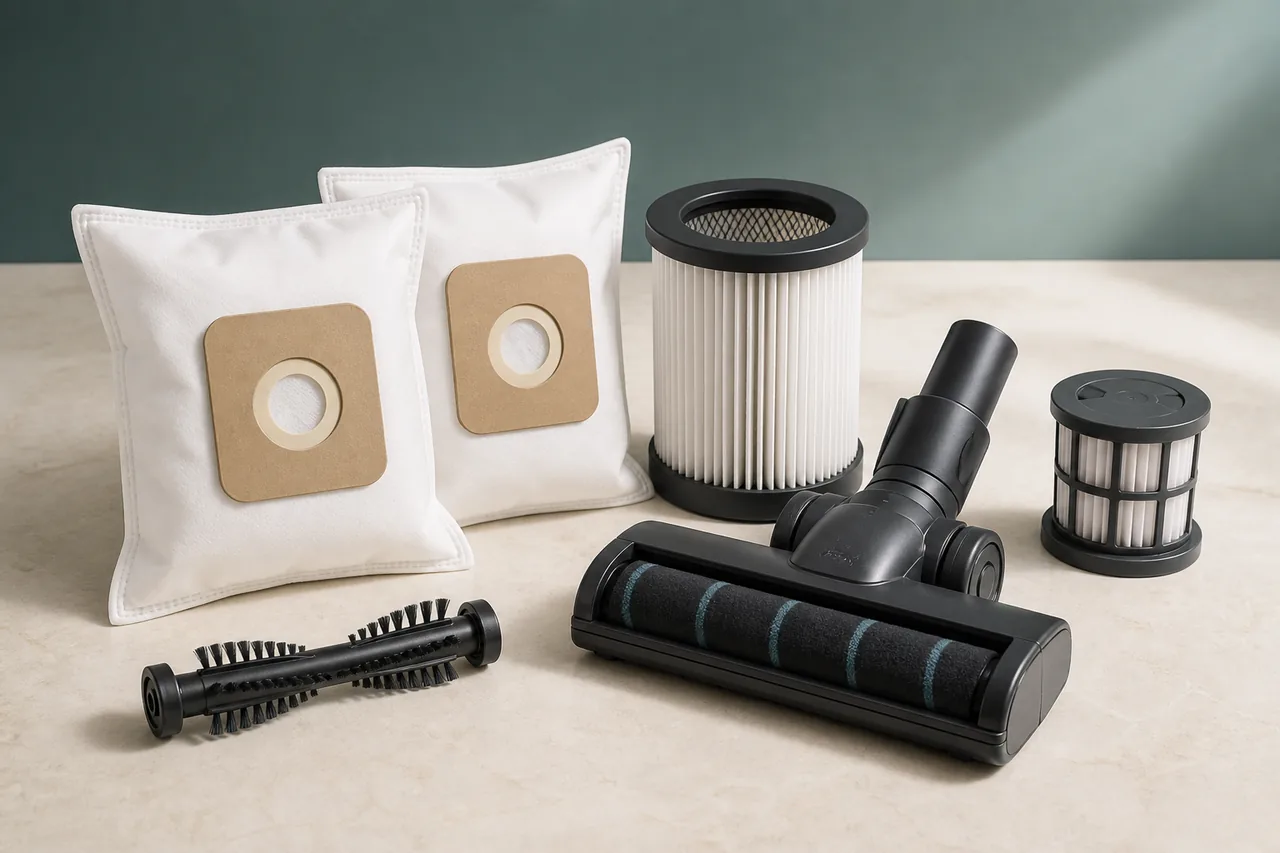
Parts
Parts and accessories for Dyson Vacuum cleaner
Compare the documented references, including 969082-01 · 970013-02. Open the part details to check the complete model code, then view the retailer’s offer.
Genuine Cyclone V10 replacement filter
Washable filter sold by Dyson for the Cyclone V10 cordless vacuum family.
Genuine Dyson V11 replacement filter
Official replacement filter listed for Dyson V11 vacuums, including named click-in battery variants.
A Dyson that repeatedly speeds up and cuts back is often reacting to restricted airflow rather than announcing an immediate motor failure. The protection response can be triggered by a full bin, a blocked inlet, debris in the wand or cleaner-head neck, or a filter that is clogged, damp or not seated correctly. Treat the pulsing as a request to trace the complete air route in a fixed order. Changing several items at once makes it harder to discover where the restriction actually was.
Begin with the machine switched off, disconnected from its charger and emptied before the MAX line. Look at the material at the bin inlet before removing accessories; compacted fluff can bridge that opening even when the bin itself does not appear completely full. Separate the cleaner head and wand, then inspect each component against the light. A clear wand does not prove that the head neck or the short path into the bin is clear, and a blockage may move when an assembly is handled, so examine every accessible junction instead of simply shaking the tube.
The behaviour with different configurations helps localise the fault. If performance changes when one tool or the cleaner head is removed, that component and its connection deserve the closest inspection. If the machine still pulses with all removable tools detached, continue with the bin inlet and filter route described for the exact model. Never run the vacuum with parts omitted unless Dyson’s own diagnostic for that machine specifically asks for such a test; the point is to compare accessible assemblies, not to bypass safety features.
Filter care is model-specific. Wash only a filter that Dyson identifies as washable, use cold water without detergent and allow it to dry naturally for at least 24 hours. “Dry on the outside” is not enough if moisture remains inside the filter material.
A damp filter can restrict air and should never be accelerated in an oven, microwave, tumble dryer, dishwasher or near a flame. Refit it only when completely dry and correctly aligned. V10 and V11 filters are not interchangeable merely because their shapes seem related, so use the full model and serial family when a replacement is genuinely required.
After clearing accessible airways and installing the dry filter, reconnect every joint until it is secure. Perform one short test in normal power rather than repeatedly using maximum mode. Steady suction indicates that an airflow restriction or filter seating issue was corrected. Pulsing that appears only with one head points back to that head. Pulsing that persists in every normal configuration, despite clear passages and the correct clean, dry filter, needs Dyson’s exact-model diagnostic.
Stop immediately for liquid inside the machine, a burning smell, unusual heat, damaged electrical contacts or an object that cannot be removed without opening the motor body. Do not probe with a sharp tool or dismantle fixed covers. The safe route ends where the accessible air path ends; persistent pulsing beyond that point is a service decision, not a reason to buy a motor or filter by guesswork.
For a confirmed replacement, distinguish Cyclone V10 filter 969082-01 from V11 filter 970013-02. Keep your machine code and open its model page before comparing sellers: buying a filter from the wrong family will not resolve a restriction. Offers in this guide remain associated with their own references. If suction is steady and only the floor brush has stopped turning, continue with the cleaner-head guide rather than treating it as a filter replacement.
Before checking Dyson Vacuum cleaner
- Never install a damp filter or dry it in a dishwasher, dryer, oven, microwave or near a flame.
What this symptom can mean on Dyson Vacuum cleaner
4 checks for Dyson Vacuum cleaner, starting with Empty and isolate
- Empty and isolate
Switch off, disconnect from the charger and empty the clear bin before the MAX line. Keep the trigger released during every check.
- Check every airway
Remove wand and cleaner head. Inspect the bin inlet, wand, head neck and accessible airways for debris, taking care around sharp objects.
- Wash and fully dry the filter
Follow the exact-model guide, rinse the washable filter with cold water only and leave it to dry completely for at least 24 hours. Refit only when touch dry.
- Reassemble and test
Refit the completely dry filter, bin, wand and cleaner head until every connection is secure. Test briefly in normal power mode and check whether suction is steady again.
When to stop checking Dyson Vacuum cleaner
- Stop if you find heat damage, a burning smell, liquid, damaged contacts or a blockage that cannot be reached without opening the motor body.
- If pulsing continues with clear airways and a clean, fully dry filter, use Dyson's exact-model diagnostic instead of opening the motor body.
Next step
After checking Dyson Vacuum cleaner: repair, part or service?
Treat “Dyson losing suction or pulsing: what to check first” as a condition to verify. The first of the 4 documented checks is “Empty and isolate”; its result guides what follows.
Finish the checks before buying
Complete the Dyson Vacuum cleaner sequence, starting at “Empty and isolate”. When the symptom clears without a remaining alert, no replacement is indicated.
Arrange a diagnosis if a stop condition appears
Do not condemn Dyson Vacuum cleaner from “Dyson losing suction or pulsing: what to check first” alone. Stop at the warnings above and let a qualified diagnosis establish whether repair remains safe and proportionate.
Sources used
- Dyson — Dyson links pulsing to airflow restriction and documents cold-water filter washing and complete drying.
Last checked: 27 August 2026