Coffee machine parts and care products›Sage›Barista Express Impress BES876 / Breville
Sage Barista Express Impress BES876 / Breville
For Sage Barista Express Impress BES876 / Breville, this catalogue documents 6 parts and accessories across Filters, Other parts, Care. Reference: SEA204WLW0ZEU1.
Confirmed parts for Sage Barista Express Impress BES876 / Breville: SEA204WLW0ZEU1, SP0001518, SP0001801, SP0013695, SP0027237, SP0101760. Each match keeps its model details, applicable regions and source.
Buying options appear beside the matching part when they are available.
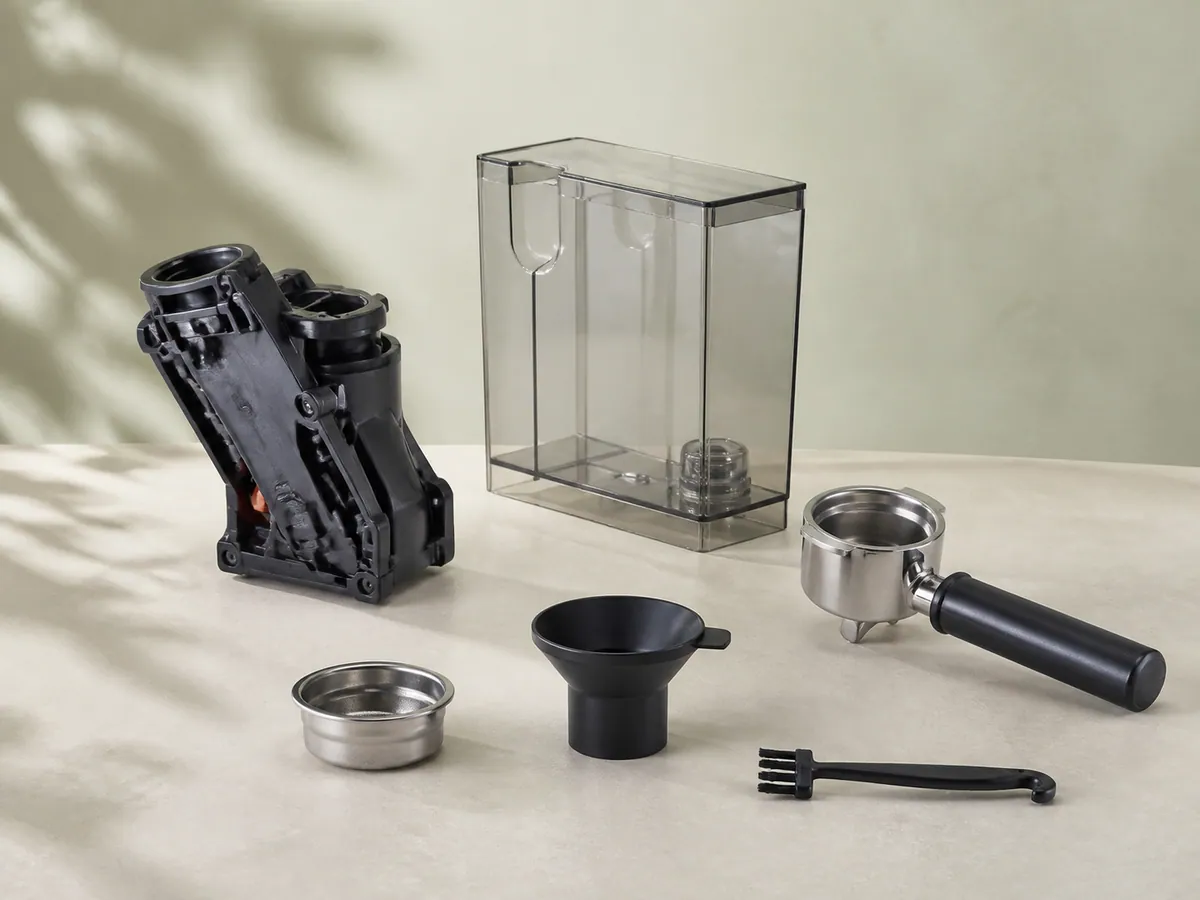
Sage official 54 mm bottomless portafilter, reference SEA204WLW0ZEU1. Compatibility is published only for the exact appliance codes explicitly listed by the manufacturer source.
Sage official 54 mm single-wall one-cup filter basket, reference SP0001518. Compatibility is published only for the exact appliance codes explicitly listed by the manufacturer source.
Sage official upper burr for machines before pdc 1926, reference SP0001801. Compatibility is published only for the exact appliance codes explicitly listed by the manufacturer source.
Sage official 54 mm cleaning disc, reference SP0013695. Compatibility is published only for the exact appliance codes explicitly listed by the manufacturer source.
Sage official 54 mm portafilter, reference SP0027237. Compatibility is published only for the exact appliance codes explicitly listed by the manufacturer source.
Sage official drip-tray grid, reference SP0101760. Compatibility is published only for the exact appliance codes explicitly listed by the manufacturer source.
Parts for Sage Barista Express Impress BES876 / Breville: references and compatibility
Which parts fit Sage Barista Express Impress BES876 / Breville?
6 documented parts are currently linked to this exact appliance. The covered families are Filters, Other parts, Care products, Racks & trays; the verified references are SEA204WLW0ZEU1, SP0001518, SP0001801, SP0013695, SP0027237, SP0101760.
How do I verify the BES876 model before ordering?
Read the complete code on the rating label, including every suffix, then compare the documented regions (US, UK, EU) and the reference printed on the part.
Why this part fits
Sage 54 mm bottomless portafilter
The official Sage / Breville source explicitly links reference SEA204WLW0ZEU1 to Sage model code BES876 or to the model-code family listed on this page.
The BES876 has become too hot and has stopped operation to protect itself; repeated immediate restarts defeat the cool-down test. Switch off, keep ventilation clear and wait 30–60 minutes before one restart; if operation stops again, leave it off and contact Sage support.
Very fine coffee is loading the grinder long enough for the BES876 to end the grind cycle on time-out. Stop, unplug and let the grinder settle, then clean the accessible conical burrs with the supplied tools and return to a coarser documented setting; never add water.
A blocked coffee chute slows delivery into the portafilter even though the grinder continues running. Stop and unplug, remove the hopper only as documented, clean the accessible chute with the supplied brush and refit every dry part before one dose.
No beans, an unlocked hopper, incomplete portafilter insertion, a low tamp lever or coffee build-up in the cradle can block the grind interlocks. Add beans, lock the hopper, raise the tamp lever fully, brush the cradle and insert the portafilter until the DOSE light illuminates; do not bypass any interlock.
An incorrect or low dose, or stale beans, may fail to create enough puck resistance for a useful pressure reading. Use fresh beans roasted 5–20 days earlier, select the correct filter size and establish the ideal dose; compare with a dual-wall basket before calling Sage.
Auto learning is suspended while the machine is in Manual mode or while the dose is being completed in Top-up mode. Press the MANUAL DOSE dial to return to Auto; during Top-up leave the portafilter in place until grinding finishes and the ideal dose is reached.
Manual dosing deliberately stops the BES876 from updating its automatic dose-level feedback. Press the MANUAL DOSE dial once to return to Auto mode, then complete one normal dose without removing the portafilter early.
Too few beans remain in the hopper for the automatic dose to finish consistently; this differs from a blocked chute. Refill the hopper with dry fresh beans and retry Auto dosing, or deliberately use Manual mode for the remaining small quantity.
The single basket is being dosed while double-filter mode is selected, so the automatic target exceeds that basket’s capacity. Stop before tamping, select the filter-size setting that matches the installed single basket and prepare a new controlled dose.
The double basket is being dosed while single-filter mode is selected, leaving the automatic target far below the basket requirement. Select the correct double-filter size for the next dose, then use Reset Auto Dose Time so learning restarts from the correct basket.
A finer setting changed the delivery rate before Auto Dose had enough information to reach the ideal level. Keep the current basket and grind unchanged, use A Bit More once to reach the ideal dose, then let the automatic system learn from that completed dose.
On BES876, an overly fine grind or an empty water tank can stop extraction even when dosing and tamping completed normally. Fill and lock the tank, discard the current puck, move one small step coarser and prepare a fresh dose; stop if the pump runs without water.
Condensed water is present while the machine heats; it should be purged before milk texturing rather than mixed into the milk. Point the wand into the drip tray, briefly purge until steam is steady, stop the control, then place the cool cleaned tip in the milk jug.
The machine is still too hot after steaming to deliver a stable hot-water stream; this is a temporary temperature state. Stop the request and allow the BES876 to cool naturally with ventilation clear, then test hot water once without repeating steam first.
A severe overdose or coffee build-up in the tamp mechanism is physically resisting the lever; forcing it risks damage. Stop pressing, use the Razor tool to trim the current dose, then remove the tamp shroud cover and brush only the accessible mechanism as documented.
Coffee grounds stuck to the tamp face make pressure uneven and leave an irregular puck surface. Raise the lever, remove the tamp shroud cover and clean the accessible tamp face with the supplied brush before preparing a new dose.
Grounds can remain on the tamp face, especially when the lever was moved too quickly, and fall back onto the finished puck. Push the tamp lever down again slowly for one polishing tamp; on the next dose use a slower continuous lever movement.
Auto mode targets the machine’s ideal tamp height by design and is not the control for a custom height. Keep Auto for the ideal-dose workflow, or deliberately select Manual dosing when custom control is required; do not recalibrate or force the lever.
The tamp stroke was not completed, so the BES876 has no finished movement from which to calculate puck height. With the portafilter correctly seated, push the tamp lever through its full controlled stroke until the confirmation beep, then return it fully home.
A flashing maintenance indicator on BES876 requests the cleaning cycle, which is distinct from the solid descaling reminder. Open Care & Cleaning and complete the BES876 cleaning cycle with the specified cleaning tablet and container; allow every rinse to finish.
A solid maintenance indicator on BES876 requests the descale cycle; a cleaning tablet cycle does not remove scale from the water path. Open Care & Cleaning, prepare the specified descaling solution and complete the BES876 descale and fresh-water rinse stages without interrupting power.